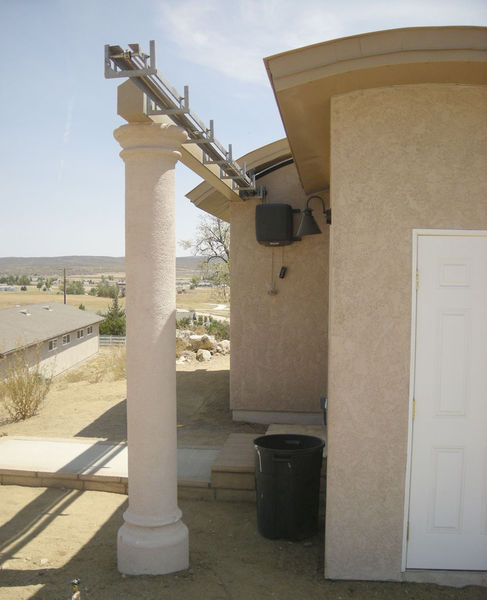
After much planning, regulatory hurdles, over seven months of construction, and one item still pending, the new observatory has seen first light. Last Wednesday I put the mount and NP-101 into the observatory and viewed the sky. I aligned the scope with no issue. My rough alignment of the pier adapter was almost spot on.
The viewing was good, but not excellent that night as the transparency was not very good. M27 was the first object I viewed. The shape was quite clear in the eyepiece. The Lagoon Nebula and the Trifid Nebula together in the 41mm Panoptic eyepiece were absolutely amazing. The Omega Nebula around M17 was great. Faint and small objects like the Cocoon Nebula or the Veil Nebula were not visible. It was great not to be bothered by the incoming light from the few security lights in the valley or the lights of passing cars.
I set up the imaging equipment on Thursday, but smoke from fires in Santa Barbara county (200+ miles away!) made serious imaging impossible. I did get the equipment working and that was a good expenditure of time. I started working with ACP observatory automation software on Friday. It took several hours to get through the set-up, and I ran into some issues in the wee hours of the morning, but again, very good progress in getting the observatory fully operational. It got quite cool on Thursday night, into the upper 40s by the time I went to bed, so being able to work in the warm room was a major advantage.
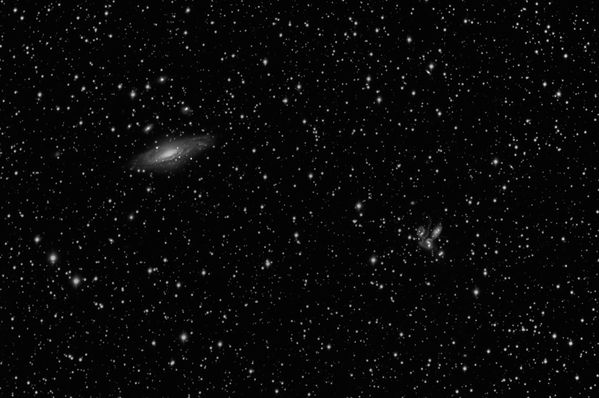
We had guests on Saturday, and Art and Tod wanted to see the observatory in action, and agreed that we could image and argue with the software rather than view. We still had some issues with the observatory control software, but solved some of them and the others are likely some configuration I have wrong at this point. We successfully captured 30 minutes of data of the Deer Lick Group and Stephan’s Quintet galaxy clusters in Pegasus. Color imaging would have kept us up too late so we settled for a nice black and white image. Click on the image to go to the gallery where you can see a larger version.
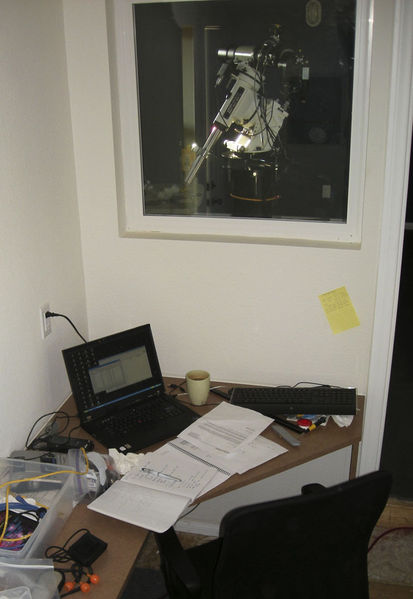
This first light milestone comes after almost all the work has been completed. The desk is in the warm room and we are just waiting on the automation for the roof. Here is a view looking into the observatory from the warm room with the new desk in the foreground.
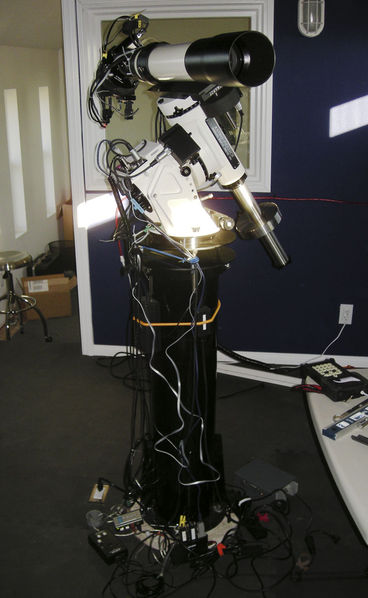
This shows the scope and mount with imaging equipment attached. The mount can carry a lot more weight than I have on it now. In fact, because the scope is small, the camera runs into the mount as the scope points close to the zenith. I may piggyback the NP-101 seen here on my C-11. That would put things at the upper end of the weight range but would also move the imaging train up and away from hitting the mount when it points to the zenith.
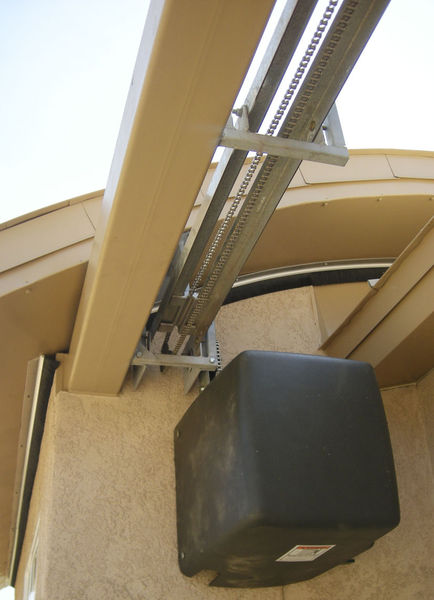
Great progress has been made and I am looking forward to getting things automated. The roof is quite heavy and can be manually moved, but motorization will be a good thing. And while I don’t plan to image remotely, automation will allow me to get a full night’s worth of data and a full night’s worth of sleep.
Like this:
Like Loading...