Archive for April, 2007

h1

10fps vs. 30fps on a ToUcam Pro

Monday, April 30th, 2007

In an excellent post on discussion thread in the Bad Astronomy / Universe Today forum, Mike (of IceInSpace) noted that the ToUcam Pro would compress data to achieve over 10 frames per second over its standard USB 1.1. This would degrade the quality of anything over this frame rate from the camera.

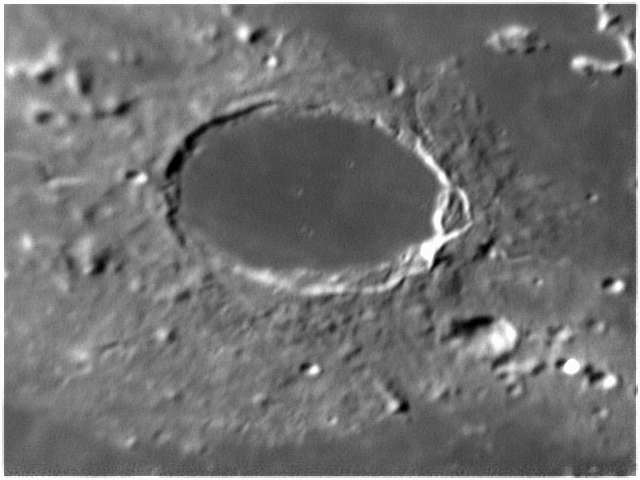
I happened to have discovered the fps control on my ToUcam over the weekend and took 2 avis of the Plato crater, one at 30 fps and the other at 10fps. This provides an excellent test case for this finding.

I have attached two jpgs, one from processing each of the AVIs in Registax. Both were processed in the same way:

  1. aligned with a single 256k box centered on the middle of the crater
  2. A reference shot of 50 frames was created and sharpened in wavelets
  3. The stack was limited to 60% and optimize
  4. The top 200 frames were selected and stacked
  5. The image was sharpened with wavelets 9.2/26.0/13.2
  6. Saved as TIFFs from Registax, JPGs and PNGs from Photshop, quality=80

No other adjustments were made to the images. The PNG images are below.

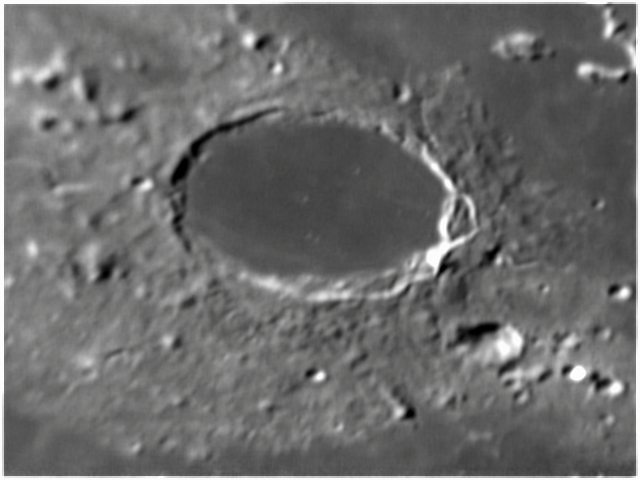
At 10 frames per second:
Plato Crater at 10fps

At 30 frames per second:
Plato Crater at 30fps

My first take is that the 30fps image has less noise. Seeing was not good, and that could be a major factor, since the improvements from faster frames could have overtaken the noise introduced from the compression in the camera.

TIFFs are available at the Observatorio de la Ballona FTP site.
h1

Plato Craterlets

Thursday, April 26th, 2007

On the plane returing from the SAP Sapphire conference in Atlanta, I was reading Sky & Telescope. In the section on Exploring the Moon. This is a regular feature and I’d link to it, but they don’t carry the story on-line, or at least not yet. It seems that is the magazine only available to April and I was reading the May edition.

It was an interesting article about the discovery of small craters on the floor of the crater Plato. Plato is a large, flat-bottomed crater near the top of the Moon, in about the center. This discovery, the article said, started a great series of discoveries of other craterlets and even transient phenomenon. At the time, people believed that the craters on the Moon were volcanic; today we know they are impact craters as the Moon has been dormant for several billion years. Altogether fun to read about the craterlets and something to look forward to seeing.

I had that opportunity last night. Having arrived in late afternoon, I was home for dinner. After dinner, I was outside with my daughter playing and I noticed the Moon. Here was my opportunity. I opened the observatory and started up the scope. There were some high clouds, so I didn’t expect great seeing and therefore I did not worry too much about scope cool down.

The Moon was one day after the first quarter, with the terminator just past the mid-line. Observing with a 22mm eyepiece (127x magnification), Plato was nicely visible, just on the light side of the terminator. Plato looked flat at first, but at select moments of still air, a craterlet would appear. It was quite exciting to see something I had read about just hours earlier. I really only saw one craterlet. At higher magnification, using a 3x barlow, the poor seeing was much worse, and the craterlet winked in and out of visibility. I can understand why people saw these objects as transient phenomenon.

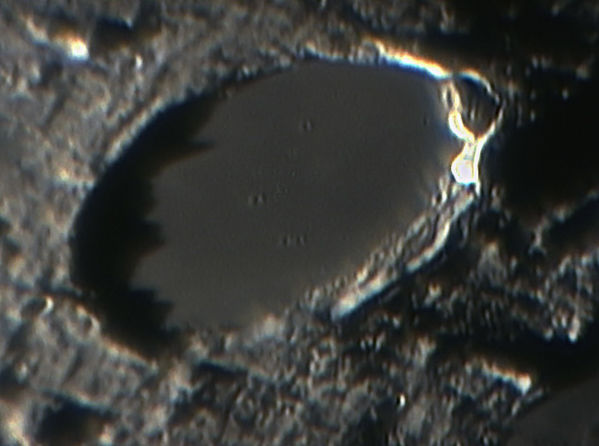
I had not planned to image that night, but the web cam was handy and easily set-up. I took one AVI of about 90 seconds. After processing in Registax, PixInsight, and Photoshop, I got the following result.

Plato Crater

There are six craterlets that I could find, four easily. These larger craterlets are from 1.7 to 2.4 kilometers in diameter.

The right side of the image is sharper because I had real trouble with Registax’s tracking and aligning except when I used a single, very large alignment box. That selected frames that were clear on the right, without regard to the clarity on the left. Hence, the right is clearer. In addition, I used sigma reject in Registax to reduce the effect of a bad pixel on my web camera.

h1

Astrophotos vs. Reality

Sunday, April 8th, 2007

On the question of "does the photo look like the real thing" I don’t think there is an easy answer. With long-exposure astrophotos such as the Eskimo Nebula from Kitt Peak, this beautiful shot of NGC 1365 on APOD (credit SSRO), or even my shot on NGC 891, there is always an element of judgement in how the astrophotographer made it look. While you can set standards on star color so your color balance reflects the true spectral colors, judgement in processing I think plays a key role.

We can leave aside narrowband or non-visible electromagnetic raditaion images. Reality vs. perception for those is like guessing what things look like to a bee or a cat.

At the Advanced Imaging Conference in San Jose last November, I listened to a discussion between David Malin (of the Anglo-Australian Observatory) and Jerry Bonnell (of NASA/USRA and co-editor of APOD). The conversation had started from the question "Does the photo look like the real thing?" in reference to astrophotos.

Malin said that, if processed correctly, the image would be the same as if we were able to turn up the magnification and sensitivity of our eyes. If we were out in space in front of the Crab Nebula (M1), we would see what the image shows us.

Bonnell, on the other hand, said that we don’t really know what things would look like if we were there. The density of the light is such that were we close to an nebula, it could be so faint as to be invisible. That even "turning up our eyes" would not necessarily yield the same colors regardless of tuning based on spectra.

My apologies to Malin and Bonnell if I have mistated their positions — this is as I recollect it.

I tend to favor Bonnell’s opinion, although I am certainly not one to pick an argument with Malin! I know that when I put together an astronomical image, I do just that — put it together. Separate images for R/G/B and Luminance, darks and flats applied, sigma reject used to reduce noise and multiple images summed, finally combining into a full-color image. Then comes sharpening with high-pass filters, digitial development, and wavelets, all that affect the relative contrast of objects in the image.

While no data is added, with all these steps I cannot assert a connection to "what it really looks like." I try to make it look pleasing to the eye, but I don’t know if it is accurate. And unless we actually go out there, with probe or spaceship, I don’t think we will know what it looks like.

Certainly good science can be done and we can know many facts about astronomical objects. Visual perception, on the other hand, is so subjective I don’t think we can say what it looks like.

h1

I’m Back

Thursday, April 5th, 2007

I’ve posted a couple of new images – Saturn and M1. I think the M1 is quite nice. On Saturn, I got carried away with noise reduction. See them at the gallery.