On the day after Thanksgiving, my wife’s sister and brother-in-law came over to Aguanga for dinner. We had a nice afternoon and grilled hambugers (I am sitll getting used to the new three-burner grill).
After dinner, my brother-in-law and I took out my old 8″ Celestron SCT on a CG-5 mount to look at the stars. It was not a very transparent night. Contrary to local averages, the dew point was above 50 degrees F, and the when we went out, the temperature was 53 and falling quickly. We had taken the scope out before dinner, so when we went out, it was already covered with dew. Using a hair drier, we dried off the Telrad, and heated up both the corrector (with the cap on) and the objective. That was just the beginning of the dew but in the end the dew did not prevent a successful night of observing.
Our first target was M31, the Andromeda Galaxy. It is dark enough in Anguanga so that with either binoculars or a telescope, you can see the elongated shape and spiral nature of the galaxy. It is visible naked eye as well.
For visual observing, Celestron’s Sky Maps is actually very useful. It charts the constellations by season, and lists findable double stars and deep sky objects for each constellation. That book guided our observing for the evening, along with my rusty object finding skills.
Our second target was M15, the globular cluster in Pegasus. It was both easy to find and wonderful to see. That was followed by M2, another beautiful globular. Though they were low in the sky, we observed Albireo and M57, the Ring Nebula.
After the look at the southern sky, we moved north and west to the faboulous Double Cluster in Perseus. It is larger than the field of view of the C-8 with a 35mm plossl, but still beautiful. Then came, for me, the highlight of the night. I found M33, the Triangulum galaxy, on the chart. I didn’t think I could find it. I did find it. We could see the circular flow of the galaxy — it filled the FOV at 35mm.
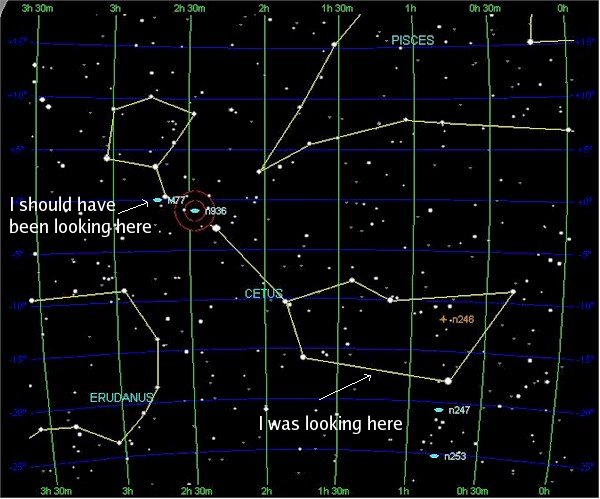
Emboldended by finding M33, I saw M77 on the chart and decided to try and find it. This is where I failed at reading a chart and looking at the sky. I thought I found Cetus, and the circle where M77 lies. I searched for probably 15 minutes (at this point, the temperature had fallen into the 40s). I never found it. My problem was that I mistook the western portion of the constellation for the eastern portion. The picture below shows my mistake. I didn’t figure this out until after all the guests had left and I looked at a wider view star chart. That wider angle helped me see my mistake in location.
At that point, we were getting cold. So we looked at M42, the Nebula in Orion. It was clearly visible even though it was only 15 to 20 degrees above the horizon. Yielding to ego, I tried to find M1, the Crab Nebula. I am fairly confident I was looking in the right place, but I could not find it.
The major side bar to the night was the dew. We had to dry off the objective every 5-10 minutes. That is what goes with working below the dew point, I guess. I imagine that the objective needs cleaning. And I found both the 99% isopropyl alchohol and the distilled water to make lens cleaner. Altogether a great night of observing. Let us all never forget that even with our wonderful detectors.
Like this:
Like Loading...